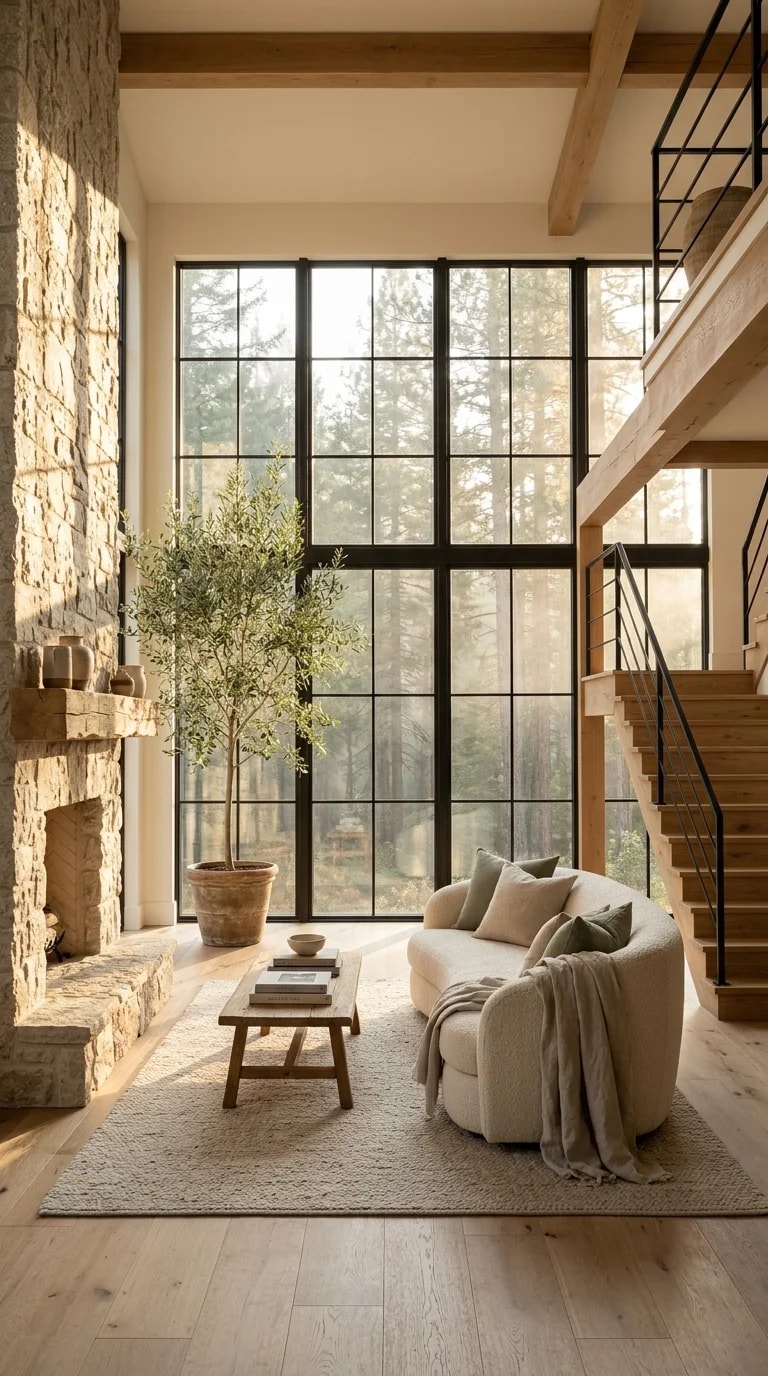
Every 60s hairstyle tutorial begins before the first sectioning clip. It begins with where you stand. A tall wall of black-framed windows, light pouring in from the left, a low table within reach for your comb and pins — that is the kind of room where a bouffant finally makes sense. The style depends on seeing what you are doing: the direction of the tease, the weight of the crown, whether the back is sitting smooth or sneaking loose. Flat overhead light hides all of it. Side light reveals it.
Set your chair so the window falls across one side of your head, then angle slightly toward the glass. In the warm, low light of late afternoon you can watch the hair lift as you backcomb, section by section, and catch the shadows that tell you where the shape is too heavy. Keep a mirror in front of you for the finished silhouette and one hand mirror for the back. The tools stay simple and close: a fine-tooth teasing comb, a natural-bristle brush for smoothing the surface, sectioning clips, a light hold spray, and a few pins in a small bowl so nothing rolls under the sofa.
Work in the same order every time, because repetition is what makes a period style look effortless rather than laboured. Section off the crown, tease from the mid-lengths downward in short strokes, then smooth only the outermost layer with the bristle brush so the volume stays underneath. Gather the rest into a soft roll or flip, pin it loosely, and let two or three tendrils fall near the cheekbone. Mist from a distance and resist touching it for a full minute. If you are filming the process, this room does half the work for you: the cream sofa and stone fireplace give a warm neutral backdrop, and the olive tree adds a little muted green so the frame never looks sterile.
Finish by stepping back into the wider part of the room, where the light softens and the long shadows fall across the oak floor. That last look in daylight, not bathroom light, is the honest test. If the volume holds and the ends still curve, you have done it properly. The room is quiet, the coffee table holds a book and a bowl, and the style reads exactly as it should — polished, a little dramatic, and completely at ease in a bright, airy space.