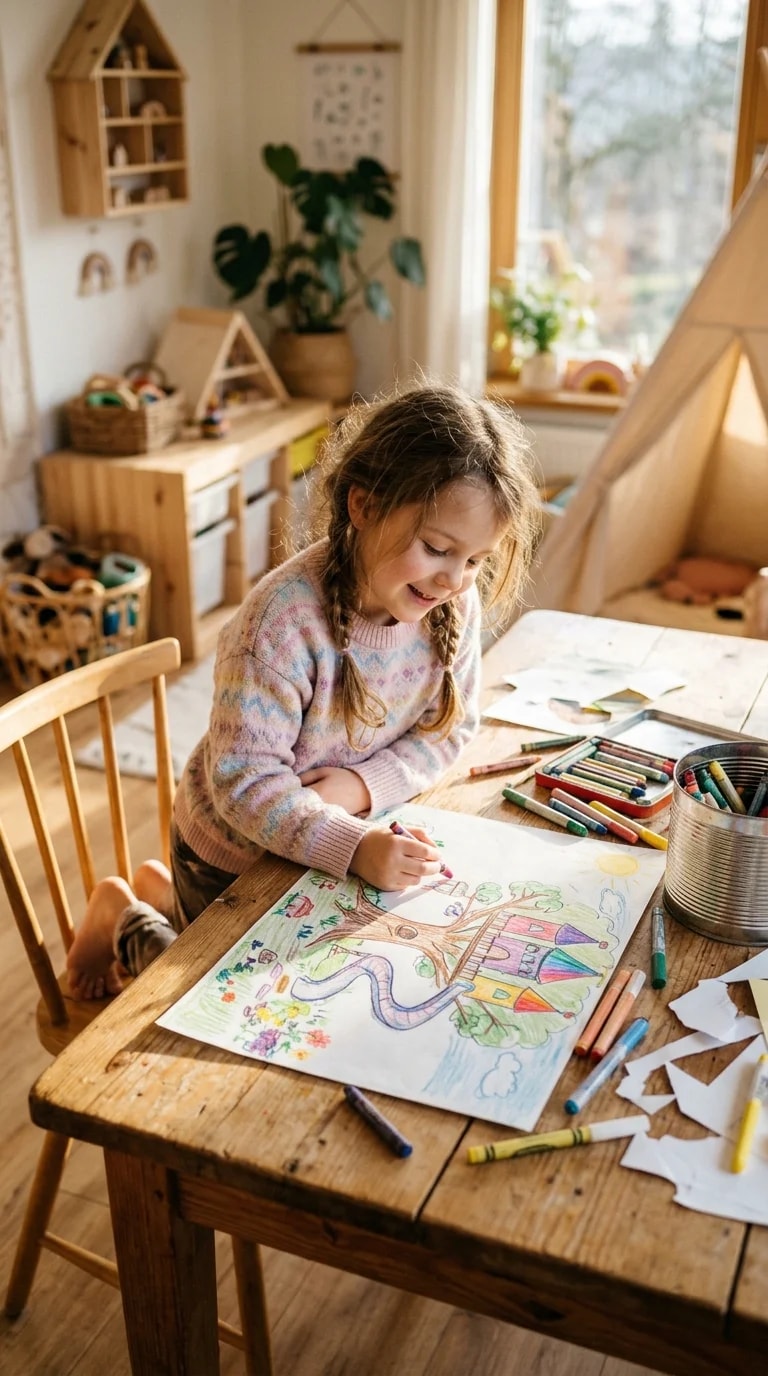
There is a small girl at a wooden table, tongue between her teeth, drawing a house with a red roof and a garden of impossible flowers. Her light brown hair is parted down the middle and gathered into two braids that have already begun to slip loose, a few strands escaping near her ears. The window light catches the fuzz at her crown. It is the kind of photograph that makes you reach for a hair tie without thinking, because the style on her head is one almost every woman has worn and almost every woman has, at some point, abandoned.
Twin braids are older than any trend report. Before curling irons, before blow-dryers, before mirrors hung at eye level, hair was divided, crossed, and tied to keep it out of the way of work, weather, and sleep. Mothers plaited daughters' hair at kitchen tables across continents, and the resulting shape — two neat ropes framing a face — reads as traditional almost everywhere. That is why it feels nostalgic even to people who never wore it. It signals care, and it signals childhood, and it does both without trying.
Worn by a grown woman, the trick is resisting the urge to make it perfect. Braid on hair that has some grip to it, whether that is second-day texture or a little salt spray worked through the lengths. Keep the tension easy so the plaits sit full rather than flat against the scalp, and stop each one an inch or two above the ends so the tie does not look harsh. Let the front decide the mood: a clean center part is crisp and slightly severe, while a soft side part with a few face-framing pieces pulled free softens everything. If two hanging braids feel too young for the occasion, pin them into a low crown, or fold each one up and tuck the tail underneath for a short, rounded shape that reads almost like a bob.
The style sits naturally with a pastel knit, a wool coat, a linen shirt, anything with texture and warmth. It works for a weekend market and for a dinner where you want to look considered rather than styled. What makes it charming is precisely what makes it traditional: the visible hand of the person who did it, the slight asymmetry, the loosening that happens by mid-afternoon.
So let the braids slip a little. That is the whole point, and it always was.