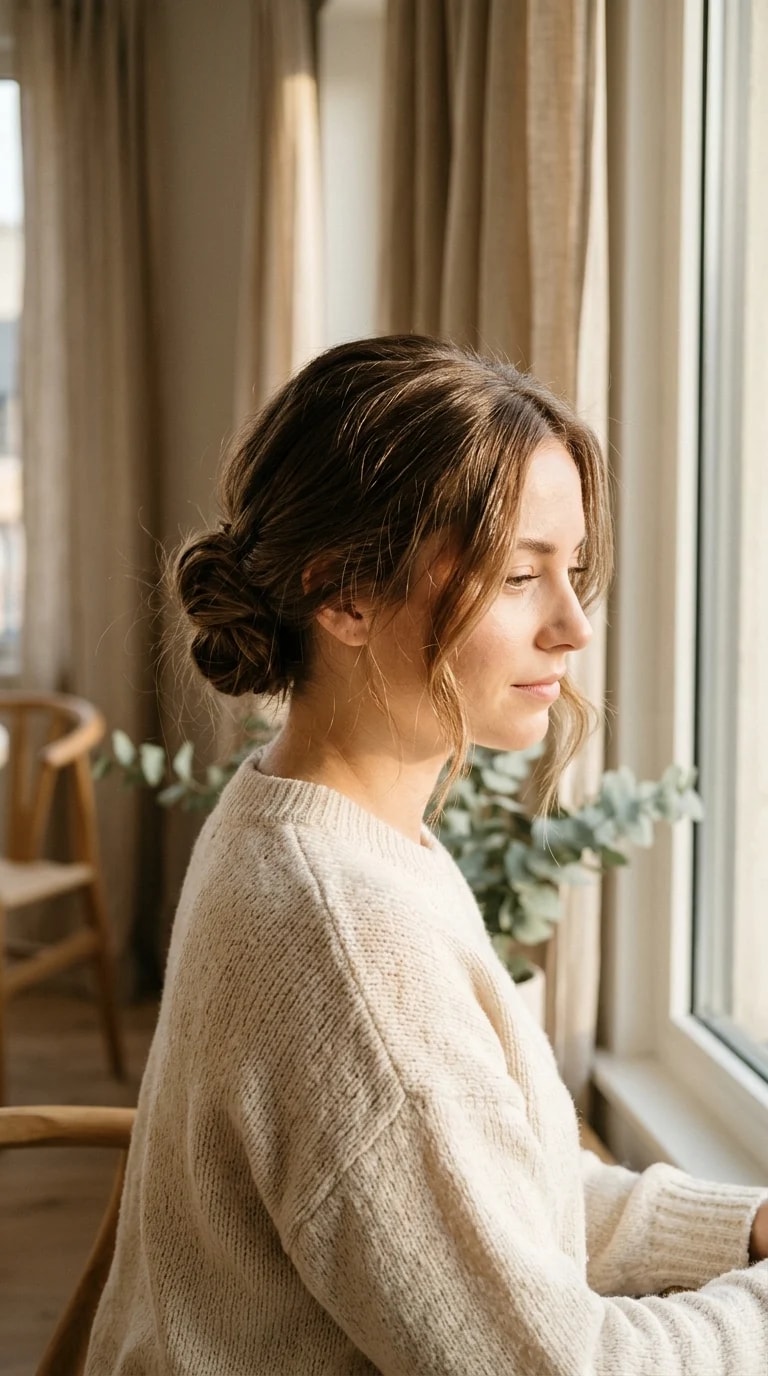
There is a particular kind of quiet in this picture: a woman in profile, chin tilted toward a bright window, a cream knit sweater slipping off one shoulder, a eucalyptus stem blurred into the background. Her hair is the whole story. Gathered low at the nape into a soft, uneven bun, it looks less styled than paused — as if she twisted it up while thinking about something else entirely. That is the trick of the everyday hairstyle done beautifully: it has to look like it happened, not like it was arranged.
Start with texture rather than smoothness. Hair that has been washed the day before holds a bun far better than freshly cleansed hair, which slips and separates. If you are working with clean hair, a few puffs of dry shampoo at the roots and through the mid-lengths will give the strand just enough grip. Rough-dry instead of brushing smooth, and skip the flat iron. The soft bends and slight frizz you are trying to eliminate are exactly what makes the finished shape read as warm and lived-in against neutral tones.
Gather everything low, sitting just above the collar of your sweater, and keep the tension loose at the scalp so the front hairline stays relaxed and slightly lifted. Twist the length into a rope, then coil it into a loop rather than a tight knot — one turn, maybe a turn and a half, pinned with two or three bobby pins pushed in horizontally. Resist the urge to tuck every end. The short pieces that spring free at the crown and around the pin line are the ones that catch the light and give the style its softness.
For the face-framing wisps, pull down a few fine sections at the temples before you pin, then twist each one lightly between your fingers so it falls in a curve instead of a straight line. If your hair is very fine, a trace of light serum on the fingertips — barely there, no shine — will keep those strands from separating into straw. Curling them away from the face with a warm iron for five seconds works too, then rake through with your fingers to break the shape up.
The setting matters more than the technique. Sit near a window in the late morning, wear something in cream or oatmeal, and let the light come from the side. Directional daylight does for a low bun what no product can: it separates the strands, lifts the texture, and turns an ordinary Tuesday hairstyle into something worth looking at twice.